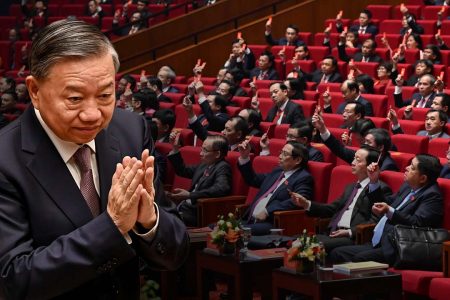
The official visit to Denmark from October 19 to 21, 2026, by General Secretary and President To Lam and his wife was intended to elevate Vietnam’s diplomatic standing in the Nordic region.
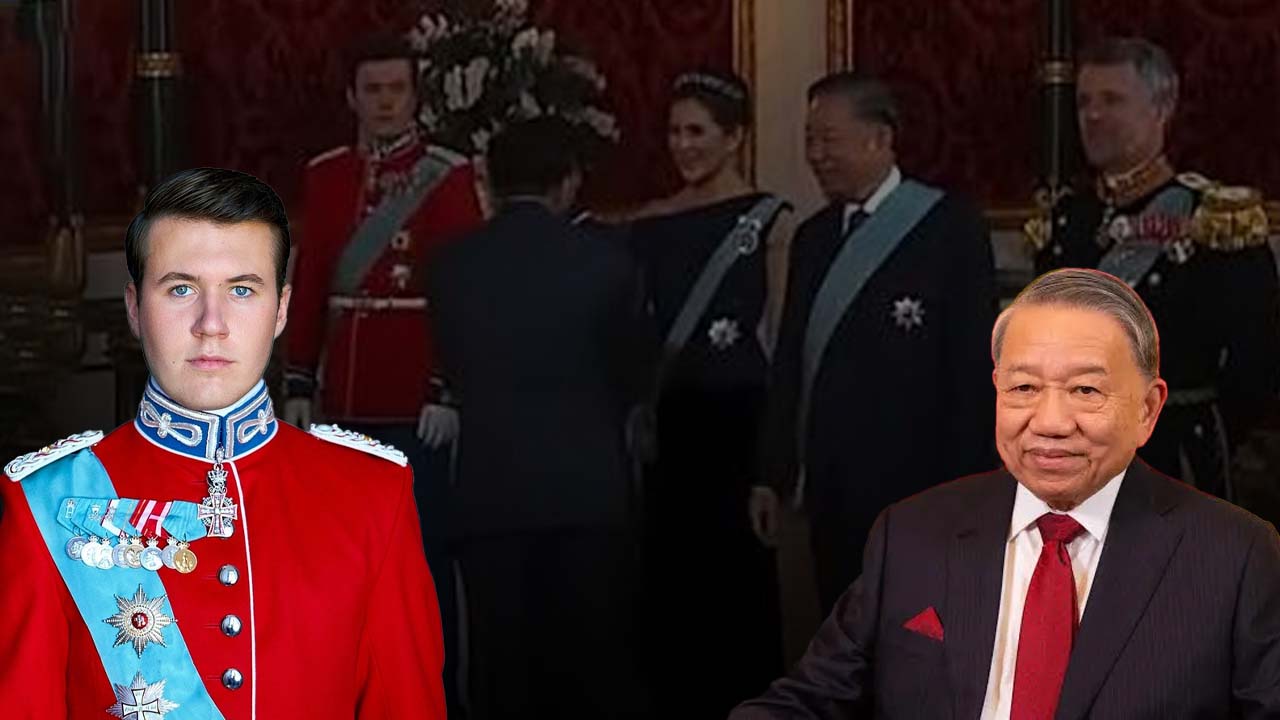
However, the focus of international media and the global online community in recent days has instead fallen on an unfortunate moment that occurred during the state banquet hosted by the Danish Royal Family.
The incident—in which a Vietnamese official walked past and ignored Crown Prince Christian, the heir to the Danish throne, without shaking his hand—has sparked a wave of fierce controversy regarding the diplomatic etiquette of officials in Ba Dinh.
A video circulating on social media platforms captures Crown Prince Christian standing in the far left position, right next to his wife, Ngo Phuong Ly.
Notably, this was the first time the future king of Denmark attended a state banquet, and the Crown Prince was dressed in the ceremonial uniform of the Royal Guard.
As the Vietnamese official approached to greet the guests, he shook hands with four high-ranking members in succession but completely ignored Crown Prince Christian, as if he did not exist.
International observers noted that the Crown Prince blushed at this somewhat unexpected behavior. However, despite finding himself in an awkward situation, Crown Prince Christian chose to respond quite gracefully by suppressing a smile and handling the situation calmly.
According to the Danish daily Billet-Bladet, in its account of the incident, the newspaper described it as a “bittersweet” situation and suggested that the Vietnamese official may have mistaken the Crown Prince for a bodyguard due to the ceremonial attire he was wearing.
However, the incident did not end with mild satire from the Western press. In Vietnam, public opinion sparked waves of harsh criticism regarding the responsibility of the protocol department as well as the conduct of the Vietnamese official.
Many outraged voices argued that this was a costly and bitter lesson in protocol. In high-level diplomatic settings, no detail—no matter how minor—can be overlooked.
A missed handshake is not merely a routine social gesture; it serves as a measure of the government’s sophistication and professionalism.
Some harsher perspectives even bluntly question the officials’ etiquette and competence, arguing that instead of spending time on resolution study sessions, officials should cultivate and master international protocol standards.
Objectively speaking, a handshake that was inadvertently overlooked does not immediately prove that the official in question intentionally acted rudely or showed disrespect toward the host country.
However, within the framework of a high-level state visit, the greeting protocol and order of reception absolutely do not allow for such a foolish mistake to occur.
The greatest responsibility in this incident lies with the protocol departments of the Ministry of Foreign Affairs and the Party Central Committee Office. They made errors in the preparation phase, failing to provide detailed guidance to officials regarding the order of protocol and the specific placement of key figures in the VIP reception line.
This oversight inadvertently placed Vietnam in an awkward position, tarnishing the professional image that the diplomatic corps has been striving to build.
International observers believe that the incident in Copenhagen was not merely a simple protocol error, but rather reflects a troubling reality regarding the limited vision and awareness of Vietnamese officials.
At a time when Mr. To Lam has been consistently emphasizing the goal of deep and extensive integration and entering a new era with greater stature, such a diplomatic blunder is a cold shower on those ambitions.
Tra My – Thoibao.de
=======